
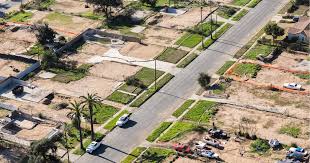
Since losing her home in the Eaton Fire, Carolina Chacon has worried about rebuilding on soil that may be contaminated.
“After the first big rain storm in October, we developed a sinkhole under where our garage was,” she said. “It was clear there was ash and fire debris in there.”
Chacon said she discovered the debris after the Army Corps of Engineers removed the top six inches of soil from her property.
“It becomes more and more clear,” Chacon said. “That’s a piece of pottery from our yard. That’s a brick from our front wall.”
She has mixed feelings about the Environmental Protection Agency’s plan to conduct soil lead testing at 100 properties within the Eaton Fire burn scar.
“I don’t think it’s sufficient, but it’s a step in the right direction,” Chacon said.
Andrew Whelton, an engineering professor at Purdue University, briefed Los Angeles County officials on soil testing after previous major disasters in California. He criticized the plan to test only for lead and to sample just 100 of the roughly 5,600 burned properties.
“If you’re only looking for lead, then you’re not going to be able to say that my soil is safe,” Whelton said.
After reviewing the soil testing protocol, Whelton said officials appeared to misunderstand the need to test for 16 additional hazardous metals.
“This wasn’t necessarily determining if people have safe properties to rebuild or if there are current health hazards due to the soil,” Whelton said. “It’s an agency coming in to look at lead only for a very small, unrepresentative number of homes. Using methods that are not necessarily designed to determine if the properties are safe, like California has used for the last 15 years.”
Whelton added that the EPA plans to collect 30 soil samples from different areas on each property and combine them into composite samples for testing.
“When you mix 30 samples together, generally, you can lower the amount of contamination that you actually see,” Whelton said.
The EPA said it would not comment on the soil testing plan until Tuesday.
Supervisor Kathryn Barger’s office, which represents communities in the Eaton Fire burn scar, said she has been briefed on the testing efforts.
“She supports efforts that provide wildfire survivors with clear science-based information about potential environmental impacts and believes education and transparency are critical as residents continue their recovery,” her office said. “Any testing that helps homeowners better understand potential risks and make informed decisions is an important part of that process.”
Concerns about possible soil contamination remain widespread in affected areas, including Altadena and Pasadena. After an initial study found higher-than-expected levels of lead and other heavy metals in wildfire-impacted communities, Los Angeles County approved a $3 million program to offer free soil testing for residents.
Additional testing by the Pasadena Public Health Department found lead levels below the California Department of Toxic Substances Control guideline of 80 parts per million and well under the Environmental Protection Agency’s threshold of 200 ppm. Tests also showed heavy metal test levels below state and federal limits.










Leave a Reply